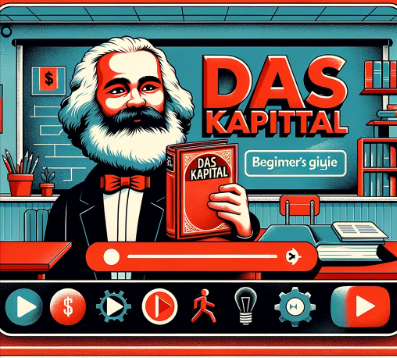
Welcome to our latest blog post, “Beginner’s Guide to Das Kapital: Understanding Marx’s Ideas”! In this post, we delve into the foundational concepts of Karl Marx’s monumental work, “Das Kapital,” making it accessible for those new to Marxist theory and economic philosophy.
Karl Marx, a philosopher and economist, wrote “Das Kapital” in the 19th century to analyze and critique the capitalist system. His work is often considered complex and challenging, but our blog post breaks down these intricate ideas into simpler terms. We explore key concepts such as the difference between use value and exchange value, the commodification of labor, and the inherent contradictions within capitalism.
Our guide starts with an overview of who Karl Marx was and the historical context in which he wrote “Das Kapital.” We discuss the industrial revolution’s impact on society, the rise of factory labor, and the exploitation of workers, which heavily influenced Marx’s thinking.
Next, we dive into the core principles of “Das Kapital.” One of the central ideas is the distinction between use value and exchange value. A commodity’s use value is its utility or usefulness, while its exchange value is determined by its ability to be traded in the market. This section also explains how labor is commodified in a capitalist system and how the value of labor is determined.
We then address the contradictions and conflicts inherent in capitalism. Marx believed that capitalism creates a perpetual struggle between capitalists, who own the means of production, and workers, who sell their labor. This conflict leads to exploitation, as workers are often paid less than the value they create. Our post illustrates these points with practical examples to enhance understanding.
Finally, we connect Marx’s theories to contemporary issues. Despite being written over 150 years ago, “Das Kapital” remains relevant today. We highlight how modern capitalism still grapples with problems like economic inequality, environmental degradation, and labor exploitation. By understanding Marx’s critique, we can better analyze these ongoing issues and seek solutions.
Whether you are a student, a professional, or simply someone curious about economic theory, our blog post aims to provide a clear and engaging introduction to “Das Kapital.” We believe that by making these concepts accessible, we can foster a deeper understanding of the economic forces shaping our world.
Don’t forget to visit our blog to read the full post and explore other insightful articles. We hope this guide inspires you to delve deeper into Marxist theory and appreciate its significance in today’s society. Thank you for joining us on this intellectual journey!



コメント