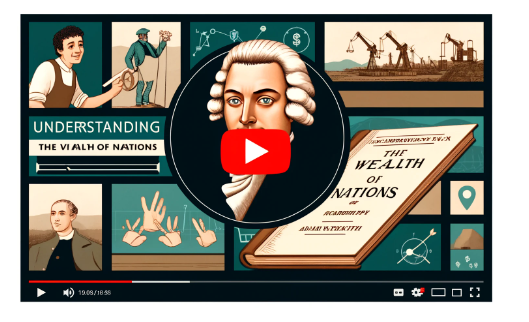
Introduction: Who Was Adam Smith?
Adam Smith is a name synonymous with economics. Known as the “Father of Modern Economics,” Smith authored the seminal work, “The Wealth of Nations,” in the 18th century. His full name was Adam Smith, and he was born in Scotland in 1723. While his education was not exceptionally advanced compared to his contemporaries, his profound thinking and unique perspective on economic phenomena set him apart.
The Wealth of Nations: An Overview
“The Wealth of Nations,” originally titled “An Inquiry into the Nature and Causes of the Wealth of Nations,” is a comprehensive examination of the capitalist society. Published in 1776 after a decade of rigorous research and writing, this book laid the foundation for classical economics. It profoundly influenced the works of later economists like David Ricardo and Karl Marx and continues to impact modern economic policies and market operations.
Key Concepts: The Invisible Hand and Free Market
One of the most famous concepts introduced by Adam Smith in “The Wealth of Nations” is the “invisible hand.” This idea suggests that individuals pursuing their own interests inadvertently contribute to the overall benefit of society. Smith believed that when people act to fulfill their own needs and desires, the market naturally adjusts, ensuring resources are distributed most efficiently.
For example, a baker aiming to sell as much bread as possible to support his family will strive to make better bread. This pursuit of personal profit results in better bread for consumers, illustrating how individual efforts can lead to societal benefits.
Smith also advocated for free market competition, arguing that excessive government intervention reduces market efficiency. He believed that competition enhances quality and keeps prices fair. However, he acknowledged the need for government roles in public services like education and justice and regulations to prevent monopolies and fraud.
Division of Labor: Enhancing Productivity
Another critical theme in “The Wealth of Nations” is the division of labor and its impact on productivity. Smith argued that dividing tasks into specialized operations significantly boosts efficiency. He used the example of pin manufacturing to illustrate this. When a single worker performs all steps, production is limited. But when each step is assigned to different workers, productivity increases exponentially.
There are three main reasons for this increase:
- Specialization allows workers to improve their skills in specific tasks.
- It reduces the time spent switching between different tasks.
- The development of specialized tools and machinery further enhances efficiency.
Smith’s insights into the division of labor are still relevant today, applicable to modern manufacturing and service industries, and form a cornerstone of economic theory.
Natural Price and Market Price: Determining the Value of Goods
Smith’s analysis of how the value of goods is determined is another crucial aspect of “The Wealth of Nations.” He distinguished between “natural price” and “market price.” The natural price is the sum of rent, wages, and profit needed to produce a good, reflecting its true value. The market price, on the other hand, is influenced by supply and demand and often fluctuates around the natural price.
For instance, if demand exceeds supply, the market price will rise above the natural price. Conversely, if supply exceeds demand, the market price will drop. Smith noted that market prices tend to gravitate towards natural prices over time, although temporary fluctuations and government regulations can cause significant deviations.
Smith also addressed the issue of monopolies, where restricted competition allows suppliers to maintain high prices, disadvantaging consumers and reducing market efficiency.
Conclusion
Adam Smith’s “The Wealth of Nations” is a foundational text for understanding economics. Learning about Smith’s life and the context in which he wrote his seminal work provides deep insights into why he is regarded as the “Father of Modern Economics.” His concepts, such as the “invisible hand,” free market principles, division of labor, and the determination of goods’ value, remain crucial in modern economic discourse.
By studying “The Wealth of Nations,” you can gain a better understanding of current economic policies and market dynamics. I highly recommend picking up this classic work to appreciate the enduring relevance of Adam Smith’s revolutionary ideas.









コメント